


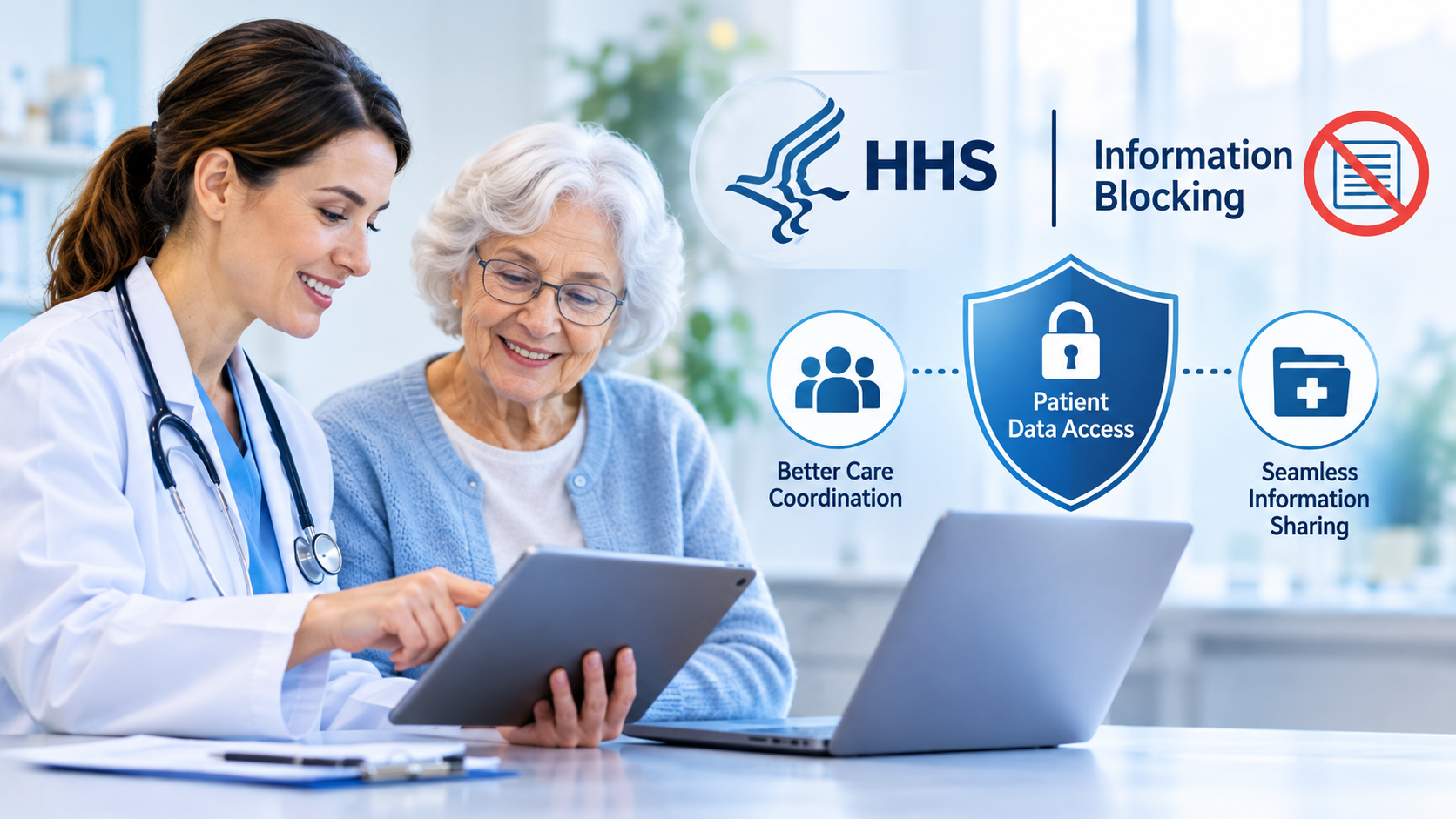
Access to accurate patient information is essential for delivering coordinated and effective healthcare. Patients need access to their medical records, while physicians, nurses, and other healthcare professionals rely on relevant clinical information to make informed decisions.
On September 3, 2025, the U.S. Department of Health and Human Services (HHS) announced increased enforcement against information blocking. The announcement reinforces the federal government’s commitment to preventing healthcare organizations and health IT entities from unnecessarily restricting access, exchange, and use of electronic health information (EHI).
For long-term care providers, this development highlights the importance of reviewing patient information access procedures, improving clinical documentation, and supporting appropriate information exchange.
Understanding these requirements can help healthcare organizations identify potential compliance risks while improving the way clinical teams manage patient information.
What Is Information Blocking Under HHS Regulations?
Information blocking refers to practices that are likely to interfere with, prevent, or materially discourage access, exchange, or use of electronic health information, except when required by law or covered by an applicable regulatory exception.
The Information Blocking Rule was established under the 21st Century Cures Act of 2016 to promote healthcare interoperability and improve access to electronic health information.
The regulations apply to three categories of healthcare actors:
- Healthcare providers: Hospitals, physicians, and other healthcare professionals and organizations that meet the regulatory definition.
- Health IT developers: Developers of certified health information technology.
- Health Information Networks and Exchanges (HINs/HIEs): Organizations that facilitate electronic health information exchange.
The regulations establish different knowledge standards for these actors. For healthcare providers, the relevant standard is whether they know that a practice is unreasonable and likely to interfere with access, exchange, or use of EHI. For certified health IT developers and HINs/HIEs, the standard is whether they know or should know that the practice is likely to interfere.
The objective is to prevent unnecessary restrictions that make it difficult for patients and authorized healthcare professionals to access important medical information.
What Does the HHS Crackdown Mean for Healthcare Providers?
HHS has announced a more active enforcement approach toward entities that engage in information blocking.
Healthcare providers should review their existing information-sharing policies, administrative procedures, and technology workflows to identify practices that could improperly restrict patient information access.
Here are some important responsibilities to understand.
1. Provide Patients With Access to Their Medical Records
Under the HIPAA Privacy Rule, patients generally have the right to inspect and obtain copies of their protected health information maintained in designated record sets, subject to specific exceptions.
Healthcare organizations should establish clear procedures for receiving and responding to patient record requests within applicable timeframes.
Patients may also have access through electronic systems and applications, depending on the available technology and applicable requirements.
2. Avoid Unnecessary Restrictions on Patient Information
Healthcare providers should not create unreasonable administrative, technical, or operational barriers that interfere with legally permitted access, exchange, or use of electronic health information.
For example, unnecessary delays or restrictive procedures that prevent authorized parties from obtaining information may raise information-blocking concerns.
Each situation must be evaluated based on the applicable regulations and circumstances.
3. Support Appropriate Health Information Exchange
Healthcare professionals often need patient information from hospitals, skilled nursing facilities, and other care settings.
Healthcare organizations should review whether their EHR systems and information-sharing processes support appropriate access and exchange between authorized parties.
4. Maintain Patient Privacy and Data Security
Improving information access does not mean removing patient privacy protections.
Healthcare providers must continue following applicable HIPAA requirements and other federal and state privacy and security laws.
The Information Blocking Rule also recognizes specific exceptions, including those related to preventing harm, privacy, security, infeasibility, and health IT performance.
These exceptions have specific conditions and should not be treated as blanket permission to restrict information.
How Does Information Blocking Affect Long-Term Care Providers?

Long-term care facilities depend on accurate and accessible patient information to maintain continuity of care.
Residents may have multiple chronic conditions, complex medical histories, medication requirements, and ongoing treatment plans. Physicians, nurses, nurse practitioners, and other care team members need relevant clinical information to understand patient conditions and make informed decisions.
When patient information is difficult to retrieve or exchange, several operational challenges can arise.
- Delayed clinical decisions: Missing or delayed clinical information can make it harder for healthcare professionals to evaluate patient conditions and determine appropriate next steps.
- Fragmented care coordination: Limited information exchange between hospitals, skilled nursing facilities, and other care settings can affect continuity of care.
- Incomplete clinical documentation: Difficulty retrieving relevant patient information can create additional work when clinicians prepare or update patient records.
- Increased administrative workload: Healthcare professionals may spend additional time navigating EHR systems, searching for records, and completing repetitive documentation tasks.
Improving information accessibility and documentation workflows can help long-term care teams address these challenges and support more coordinated patient care.
What Are the Penalties for Information Blocking?
The HHS announcement highlights the consequences that may apply when an actor is found to have committed information blocking.
The consequences depend on the type of organization and the applicable enforcement framework.
- Healthcare providers: Certain eligible hospitals, critical access hospitals, MIPS-eligible clinicians, and Medicare Shared Savings Program ACOs and associated participants may face program-specific CMS disincentives.
- Certified health IT developers: Developers found to have committed information blocking may face civil monetary penalties of up to $1 million per violation.
- Health Information Networks and Exchanges: Entities meeting the applicable regulatory definitions may also face civil monetary penalties of up to $1 million per violation.
- Certified health IT products: Developers may face additional consequences, including termination of product certifications and exclusion from the ONC Health IT Certification Program, where applicable.
These consequences are not automatically imposed for every delay or restriction involving patient information. They depend on the applicable legal requirements and enforcement findings.
Healthcare organizations should therefore review their information-sharing practices and address unnecessary barriers to legally permitted access.
How MDOps Can Help Healthcare Providers Meet HHS Requirements
MDOps is an AI-powered tool designed for Long-Term Care (LTC) practitioners to help prevent hospital readmissions and become hospitals’ preferred partners.
By signing up for the Patient Portal, healthcare providers can automate the sharing of health information with patients and their care providers through a secure, mobile-friendly web portal. This helps patients better manage their chronic conditions while promoting greater transparency.
MDOps supports healthcare providers in improving patient information access and care coordination. Providers should continue to follow all applicable HHS, HIPAA, and information-blocking requirements.
MDOps is a certified PointClickCare and MatrixCare partner.
Schedule a quick call to learn more or request a free demo.
Other Notable Features of MDOps:
- Drive patient adherence to prescribed treatments.
- Meet quality measure reporting criteria.
- Ensure continuity of care during every care transfer.
- Improve patient satisfaction.
- Provide quick and timely access to patient condition information through the mobile app.
- Ensure accurate census information.
How Long-Term Care Facilities Can Prepare for HHS Information Blocking Enforcement
Healthcare organizations can take practical steps to evaluate their current information-sharing practices.
- Review patient access procedures: Ensure that patients and their personal representatives can submit and receive medical record requests through appropriate processes.
- Identify unnecessary restrictions: Examine administrative and technical barriers that could interfere with legally permitted information access.
- Evaluate EHR systems: Review whether existing systems support appropriate information retrieval and exchange.
- Maintain privacy and security: Ensure that information-sharing procedures follow HIPAA and other applicable legal requirements.
- Improve clinical documentation: Consider technology that helps clinicians maintain accurate and accessible patient records.
- Educate healthcare staff: Make sure employees understand patient access responsibilities and organizational information-sharing policies.
These steps can help long-term care facilities identify workflow gaps, strengthen information management practices, and support better coordination across care teams.
Conclusion
The HHS crackdown on information blocking reinforces an important responsibility across the healthcare industry: electronic health information should not be unnecessarily restricted when access, exchange, or use is legally permitted.
For long-term care providers, this makes appropriate patient information access, efficient clinical documentation, and coordinated healthcare workflows increasingly important.
Technology like MDOps helps healthcare providers streamline patient information sharing, improve care coordination, and simplify everyday clinical workflows through AI-powered tools and a secure Patient Portal.
By combining appropriate information-sharing practices with efficient clinical technology, long-term care organizations can reduce administrative challenges and support better-informed patient care. Get in touch for more information!
Frequently Asked Questions
1. Does HHS require all healthcare providers to share patient medical records?
Healthcare providers must avoid practices that constitute information blocking under applicable regulations. Patients also generally have the right to access their health information under HIPAA. However, sharing must follow applicable privacy, security, and regulatory requirements.
2. What is information blocking in healthcare?
Information blocking refers to practices that interfere with, prevent, or materially discourage the access, exchange, or use of electronic health information, unless required by law or covered by an applicable exception.
3. What happens if a healthcare provider engages in information blocking?
Certain healthcare providers may face CMS program-specific disincentives. Certified health IT developers and qualifying health information networks or exchanges may face civil monetary penalties of up to $1 million per violation.
4. How can long-term care facilities improve patient information access?
Facilities can improve patient record request procedures, streamline EHR workflows, reduce unnecessary administrative barriers, protect patient privacy, and use technology that supports efficient documentation and information retrieval.
5. How can MDOps help long-term care providers?
MDOps helps automate health information sharing through its secure Patient Portal, improve patient access, and support care coordination while helping providers manage chronic conditions. Providers must continue to follow applicable HHS, HIPAA, and information-blocking requirements.