


The HHS information blocking crackdown brings important responsibilities into focus for long-term care (LTC) providers. Beyond maintaining patient records, healthcare organizations need to consider how easily patients and authorized care providers can access and exchange electronic health information when needed. As AI in long term care and other digital technologies become more common, maintaining appropriate access to patient information is also an important part of connected care.
On September 3, 2025, the U.S. Department of Health and Human Services (HHS) announced increased enforcement efforts against practices that interfere with the access, exchange, or use of electronic health information. A joint enforcement alert from the Office of Inspector General (OIG) and the Office of the National Coordinator for Health Information Technology (ONC) followed on September 4, 2025.
For LTC providers, these developments raise practical questions: Which organizations could face consequences? What steps should providers take? And how can tools such as a secure Patient Portal support better information access and coordination? This article explores these questions and explains what the HHS crackdown means for long-term care organizations.
For a broader understanding of the regulations, enforcement requirements, and patient data access responsibilities, read our guide on What Providers Need to Know About Information Blocking ?
How Can an LTC Patient Portal Improve Patient Access and Transparency?
Patient access to health information is an important part of modern healthcare. Long-term care patients often receive ongoing treatment and support, making it important for them and their authorized caregivers to stay informed about their health.
A secure, mobile-friendly Patient Portal can help LTC providers make relevant health information available to patients and their authorized care providers. Instead of relying entirely on paper records or repeated requests, users can access available information through a convenient online platform.
Here are some important benefits of a Patient Portal for long-term care providers.
1. Easier Access to Medical Information
A Patient Portal allows patients and authorized caregivers to view relevant health information online. Depending on the portal’s capabilities and access permissions, this may include clinical notes, laboratory results, medication information, and care plans.
Having convenient access to this information can help patients and caregivers better understand ongoing care and remain informed about important health updates.
2. Better Support for Chronic Condition Management
Many long-term care patients require continuous monitoring and treatment for chronic health conditions. Access to relevant medical information can help patients and caregivers stay informed about care plans, medication details, and clinical updates.
This supports better participation in care discussions and helps patients understand the information shared by their healthcare providers.
3. Improved Communication Between Patients and Providers
A Patient Portal can provide an additional communication channel between patients, caregivers, and healthcare professionals.
Patients and authorized caregivers can use available communication features to ask questions, request clarification, and stay connected with the care team. This can reduce communication gaps and support more informed care discussions.
4. Greater Transparency in Patient Care
When patients can review their available medical information, they gain better visibility into their healthcare journey.
Access to clinical notes, laboratory results, and care plans can help patients understand the services they receive and participate more actively in healthcare decisions.
5. Convenient Access Across Web and Mobile
A secure Patient Portal, available both as a web portal and as native iOS and Android apps, makes it easier for patients and authorized caregivers to access available information from their device of choice.
This is particularly useful for family members who may not always be physically present at a long-term care facility but want to stay informed about a loved one’s care
A Patient Portal can support healthcare interoperability and healthcare data sharing when it is appropriately connected to relevant systems and configured with suitable access permissions. However, having a portal alone does not guarantee regulatory compliance. Organizations must also review their information-sharing policies, access procedures, and applicable privacy and security requirements.
How MDOps Patient Portal Supports Long-Term Care Providers
MDOps provides technology designed to support clinical workflows and patient information access in long-term care settings. MDOps’ AI healthcare solutions are intended to help practitioners manage information and support connected clinical operations.
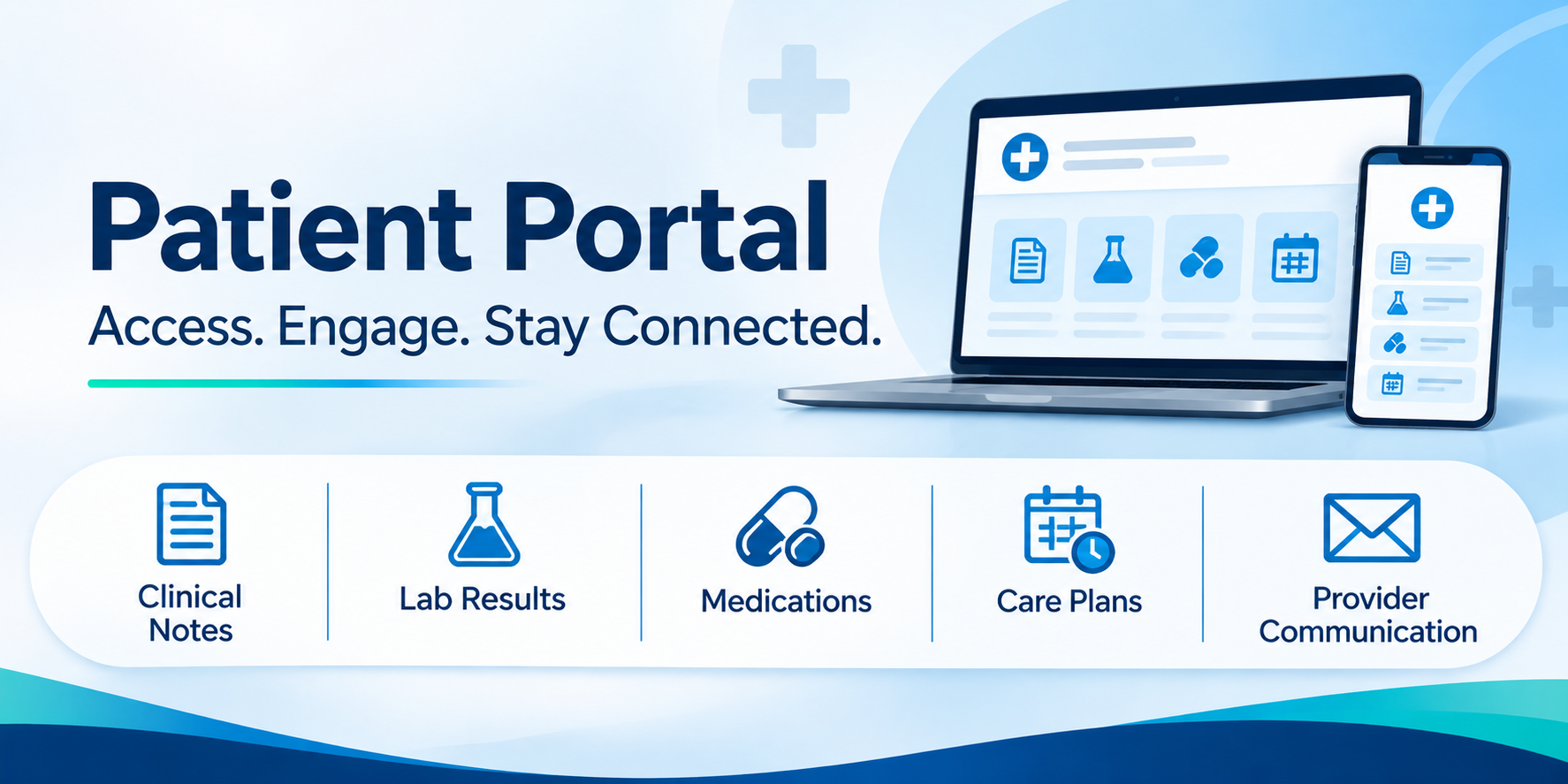
MDOps Patient Portal supports the automated sharing of health information with patients and their care providers through a secure portal — accessible via web browser and through dedicated iOS and Android apps. This helps provide greater visibility into available patient information and supports ongoing communication
Key capabilities include:
- Clinical Notes: Patients and authorized caregivers can view and download available medical notes.
- Laboratory Results: Users can access available laboratory information through the portal.
- Medication Information: Relevant medication details can be reviewed online.
- Care Plans: Patients and authorized caregivers can view and download available care plans.
- Provider Communication: Patients and caregivers can contact their healthcare provider directly through email.
By making relevant health information easier to access, the MDOps Patient Portal can support patient engagement, transparency, and communication between patients and care teams.
MDOps also supports clinical workflows through its long-term care solution, including integration with PointClickCare and MatrixCare. These capabilities help practitioners work with available patient information and support connected clinical operations. A Healthcare AI platform can bring together tools that support documentation, risk identification, and other routine clinical workflows.
As AI in long term care continues to develop, AI healthcare solutions can also help practitioners manage documentation, organize clinical information, and support routine workflows. AI in healthcare can complement these processes, while a Healthcare AI platform may bring together tools for documentation, risk identification, and workflow support.
AI medical software and other digital healthcare tools can help improve operational efficiency, but they do not replace secure information exchange or the organization’s responsibility to follow applicable regulations.
Should Healthcare Providers Be Worried About the HHS Information Blocking Crackdown?
Healthcare providers should take the HHS announcement seriously, but they should also understand what information blocking means before assuming that every delay or restriction is a violation.
Information blocking generally involves a practice that is likely to interfere with, prevent, or materially discourage the access, exchange, or use of electronic health information, when the practice meets the applicable knowledge and other regulatory requirements.
Healthcare providers can review the official HHS Information Blocking Regulations to understand the applicable requirements, exceptions, and responsibilities.
For example, potential information-blocking concerns may arise when an organization:
- Unreasonably delays providing electronic health information to an authorized patient or healthcare provider.
- Restricts access to patient records without an applicable legal or regulatory reason.
- Creates unnecessary barriers to sharing information with authorized healthcare applications.
- Uses technical or contractual restrictions that interfere with legitimate information exchange.
- Fails to support appropriate information-sharing requests from other healthcare providers.
However, healthcare organizations are still required to protect patient privacy and information security. Certain practices may be permitted under the regulatory exceptions, and organizations may need to restrict access when required by applicable law.
For LTC providers, reviewing these practices is particularly important because patient care often involves multiple practitioners, facilities, family caregivers, and external healthcare organizations.
The HHS enforcement alert identifies several priorities for OIG investigations, including practices that cause or could cause patient harm, significantly affect a provider’s ability to deliver care, continue for a long period, or cause financial losses.
The purpose is not simply to encourage organizations to share information without restrictions. It is to ensure that legitimate access and exchange are not unnecessarily blocked.
Which Healthcare Providers and Facilities Could Face Disincentives?
One of the most important questions for LTC administrators is whether their organization could face financial or program-related consequences for information blocking.
The answer depends on the provider’s status and participation in applicable healthcare programs.
Under the HHS provider disincentives framework, CMS has established consequences for specific categories of healthcare providers found by OIG to have committed information blocking.
1. Eligible Hospitals and Critical Access Hospitals
Hospitals participating in the Medicare Promoting Interoperability Program may face consequences if they are determined to have committed information blocking.
An eligible hospital may be treated as not being a meaningful EHR user, which can affect its annual market basket update. A critical access hospital may receive 100% of its reasonable costs instead of the 101% it could otherwise receive under the applicable program.
2. MIPS-Eligible Clinicians
Clinicians participating in the Merit-based Incentive Payment System (MIPS) may receive a zero score in the Promoting Interoperability performance category if they are subject to the applicable information-blocking disincentive.
This can affect their overall MIPS performance and potential payment adjustment.
3. Medicare Shared Savings Program Participants
Healthcare providers participating in a Medicare Shared Savings Program Accountable Care Organization (ACO) may face removal or denial of participation for at least one year, depending on the applicable determination and program requirements.
What Does This Mean for Long-Term Care Facilities?
Not every nursing home, skilled nursing facility, or LTC organization automatically faces the same CMS disincentives.
The specific consequences depend on whether the organization or relevant provider falls within the applicable regulatory definitions and participates in a program covered by the disincentives.
However, LTC organizations should not ignore information-blocking requirements simply because a particular CMS payment consequence may not apply to them. Healthcare providers covered by the information-blocking regulations still need to understand their responsibilities and avoid practices that improperly restrict electronic health information.
What Actions Has HHS Already Taken? Key Enforcement Dates and Developments
The HHS information-blocking crackdown is not a proposal waiting for a future compliance date. The underlying regulations and relevant enforcement mechanisms have already been established.
Here are the key developments healthcare providers should understand.
April 5, 2021 – Information Blocking Regulations Became Applicable
The information-blocking regulations under 45 CFR Part 171 became applicable. These regulations established requirements addressing practices that interfere with the access, exchange, or use of electronic health information.
They also identified specific exceptions for certain practices that meet their conditions.
June 27, 2023 – OIG Finalized Its Enforcement Rule
HHS-OIG published its final rule implementing civil monetary penalties for certain information-blocking actors, including developers of certified health IT and qualifying health information networks and exchanges.
These entities may face penalties of up to $1 million per violation when OIG determines that information blocking has occurred.
July 1, 2024 – Provider Disincentives Final Rule Published
HHS published its final rule establishing specific disincentives for certain healthcare providers found by OIG to have committed information blocking.
The rule became effective on July 31, 2024, and CMS applies the relevant disincentives through designated Medicare programs.
September 3, 2025 – HHS Announced Increased Enforcement
HHS announced that it would dedicate additional resources to identifying and addressing information blocking.
The announcement emphasized patient access to electronic health information and the need to hold responsible entities accountable.
September 4, 2025 – OIG and ONC Issued a Joint Enforcement Alert
OIG and ONC issued an enforcement alert confirming their commitment to intensifying investigations and enforcement activities.
The alert explained that investigations would prioritize practices that cause or could cause patient harm, significantly affect patient care, continue for long periods, or result in financial losses.
February 11, 2026 – First Nonconformity Notices Issued
At the ASTP/ONC 2026 Annual Meeting, HHS Assistant Secretary for Technology Policy Thomas Keane announced that ASTP/ONC had begun issuing letters of nonconformity to certified EHR developers — citing concerns related to API performance, interoperability, and potential information-blocking practices. This marked the first concrete enforcement action since the regulations took effect in 2021.
June 2026 – Enforcement Expanded to Provider Organizations
Keane confirmed that HHS had begun issuing notices of nonconformity to healthcare organizations found to be blocking patient information, with some entities placed on corrective action plans after acknowledging noncompliance. More than 2,000 information-blocking complaints had been submitted through ASTP/ONC’s portal by this point.
October 2026 – Seven Nonconformity Letters Confirmed
Speaking at the ADAPT conference, Keane disclosed that HHS had issued seven letters of potential nonconformity to companies over information blocking. He noted that most recipients had remediated the flagged practices and agreed to change their data-sharing behavior, while HHS continues to pursue enforcement where voluntary compliance doesn’t follow.
These developments confirm that information-blocking enforcement is no longer a future requirement—it is an active process already producing real consequences, including corrective action plans and formal nonconformity determinations against both health IT developers and provider organizations.
How Much Time Do Healthcare Providers Have to Prepare?
There is no single new compliance deadline or countdown applying to every healthcare provider following the September 2025 HHS announcement.
The underlying information-blocking requirements were already applicable from April 5, 2021, and the relevant enforcement framework is active.
Therefore, healthcare providers should not wait for another deadline before reviewing their practices.
Long-term care organizations can use this time to:
- Review how patients and authorized representatives request and receive electronic health information.
- Identify unnecessary delays or restrictions in patient information access.
- Evaluate whether existing EHR systems and patient portals support appropriate information exchange.
- Review contracts, internal policies, and technical processes that could create barriers to healthcare data sharing.
- Train staff on patient information access and appropriate information-sharing procedures.
Organizations should also remember that using a Patient Portal or adopting new AI healthcare solutions does not automatically establish compliance. The organization’s actual practices and applicable regulatory obligations remain important.
How Long-Term Care Providers Can Prepare for Increased Enforcement
Beyond understanding the HHS announcement, LTC organizations should focus on improving the way their teams manage and share patient information.
The following steps can help organizations identify gaps and improve their processes.
1. Review Patient Information Access Procedures
Examine how patients, authorized caregivers, and other healthcare providers request and receive electronic health information.
Identify unnecessary delays, inconsistent procedures, or restrictions that may interfere with legitimate access.
2. Evaluate Existing Healthcare Technology
Review whether current EHR systems, patient portals, and connected applications support appropriate information access and exchange.
Consider whether the technology supports healthcare interoperability with other systems involved in patient care.
3. Check Portal Access and Permissions
Ensure that Patient Portal access is configured appropriately for patients and authorized representatives.
Review authentication, authorization, user permissions, and security processes to help protect sensitive information.
4. Review Information-Sharing Policies
Examine internal procedures, contracts, and technical restrictions that could interfere with legitimate information exchange.
Make sure staff understand when information can be shared and when a restriction is legally or operationally necessary.
5. Educate Staff and Administrators
Help administrators, practitioners, and support teams understand how information-blocking requirements affect their responsibilities.
Training can help employees respond consistently to patient requests and information-sharing needs.
6. Document Information-Sharing Processes
Maintain clear records of information-access requests, decisions, applicable restrictions, and the reasons for any delays or denials.
Good documentation can help organizations review their practices and respond more effectively if questions arise.
Healthcare organizations should also consult qualified compliance or legal professionals when assessing whether specific practices meet applicable regulatory requirements.
Conclusion
The HHS information-blocking crackdown is an important reminder that healthcare information should be accessible to authorized individuals when it is needed. For long-term care providers, this means reviewing information-sharing practices, understanding which enforcement consequences may apply, and making sure technology does not create unnecessary barriers to patient access.
A secure Patient Portal can help LTC organizations improve transparency by giving patients and authorized caregivers convenient access to relevant medical information. Solutions such as MDOps can support these efforts through patient-facing access and connected clinical workflows.
As healthcare interoperability and healthcare data sharing become increasingly important, LTC providers should evaluate how their existing technology supports patient access and communication. AI in long term care and other digital healthcare solutions may also help improve clinical workflows, but they should complement—not replace—appropriate information-sharing practices.
Rather than waiting for another enforcement announcement or deadline, long-term care organizations should review their current processes and consider how better information access can support patient engagement and everyday care delivery.
Looking to improve patient information access and streamline your long-term care workflows? Get in touch with MDOps to explore how our solutions can support your organization.
Frequently Asked Questions
1. Can long-term care providers be investigated for information blocking?
Healthcare providers covered by the information-blocking regulations can be investigated if they are suspected of engaging in practices that improperly interfere with the access, exchange, or use of electronic health information.
2. Does every nursing home face CMS financial penalties for information blocking?
No. CMS has established specific disincentives for certain provider categories participating in designated Medicare programs. Not every nursing home or LTC facility automatically faces the same financial consequences.
3. Is there a new HHS information-blocking compliance deadline?
There is no single new deadline for all providers resulting from the September 2025 HHS announcement. The information-blocking regulations and relevant enforcement mechanisms are already in effect.
4. How does a Patient Portal support healthcare data sharing?
A Patient Portal can give patients and authorized caregivers secure online access to available medical notes, laboratory results, medications, and care plans. It can also provide communication features that help patients stay connected with healthcare providers.
5. Does having a Patient Portal automatically make an LTC facility compliant?
No. A Patient Portal can support patient access and transparency, but it does not automatically establish regulatory compliance. Organizations must review their own policies, technology, access procedures, and information-sharing practices.
6. How can AI in long-term care support healthcare providers?
AI in long-term care can support activities such as clinical documentation, workflow automation, patient risk identification, and organizing clinical information. These tools can help practitioners manage routine tasks, but they do not replace clinical judgment or regulatory responsibilities.