


Introduction
Long-term care practitioners manage many responsibilities throughout the day, from monitoring residents and coordinating with care teams to updating records and communicating with families. Clinical documentation is essential to this work, but completing notes accurately and on time can add considerable pressure to an already demanding schedule.
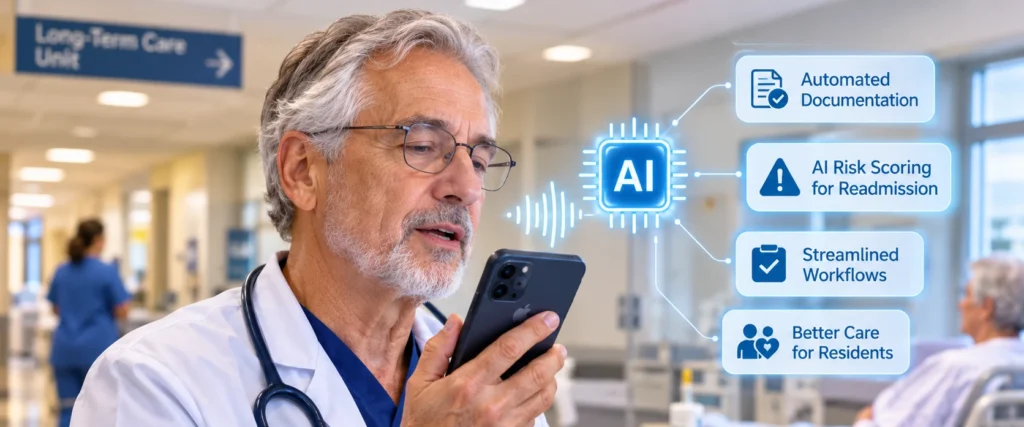
This is where AI clinical documentation can help. AI-powered tools can assist practitioners by converting relevant clinical conversations or dictated observations into structured draft notes, organizing information, and reducing some of the repetitive work associated with documentation.
When implemented carefully, AI medical documentation tools can support more efficient recordkeeping while allowing practitioners to remain focused on clinical judgment and resident care. However, these systems are intended to assist qualified professionals, not replace their responsibility for reviewing and approving clinical records.
Explore how an AI-powered long-term care solution can support practitioners with documentation and daily clinical workflows.
Why Clinical Documentation Is Challenging in Long-Term Care
Long-term care settings require consistent, detailed records because residents may have ongoing medical conditions, complex care needs, and changing health statuses. Practitioners must document assessments, medication-related observations, treatment plans, progress notes, and changes that require follow-up.
Several challenges can make this process difficult:
- Time pressure: Practitioners must balance documentation with direct resident care and other clinical responsibilities.
- Repeated data entry: Similar information may need to be recorded across different forms or systems.
- Incomplete or delayed notes: Busy shifts can make it harder to finish records promptly.
- Communication gaps: Missing or unclear information can complicate handovers between staff members.
- Complex resident histories: Practitioners need to distinguish current observations from previous diagnoses, treatments, and care plans.
Documentation technology cannot eliminate every challenge. However, well-designed AI in healthcare tools may help reduce routine administrative work and make important information easier to review.
What Is AI Clinical Documentation?
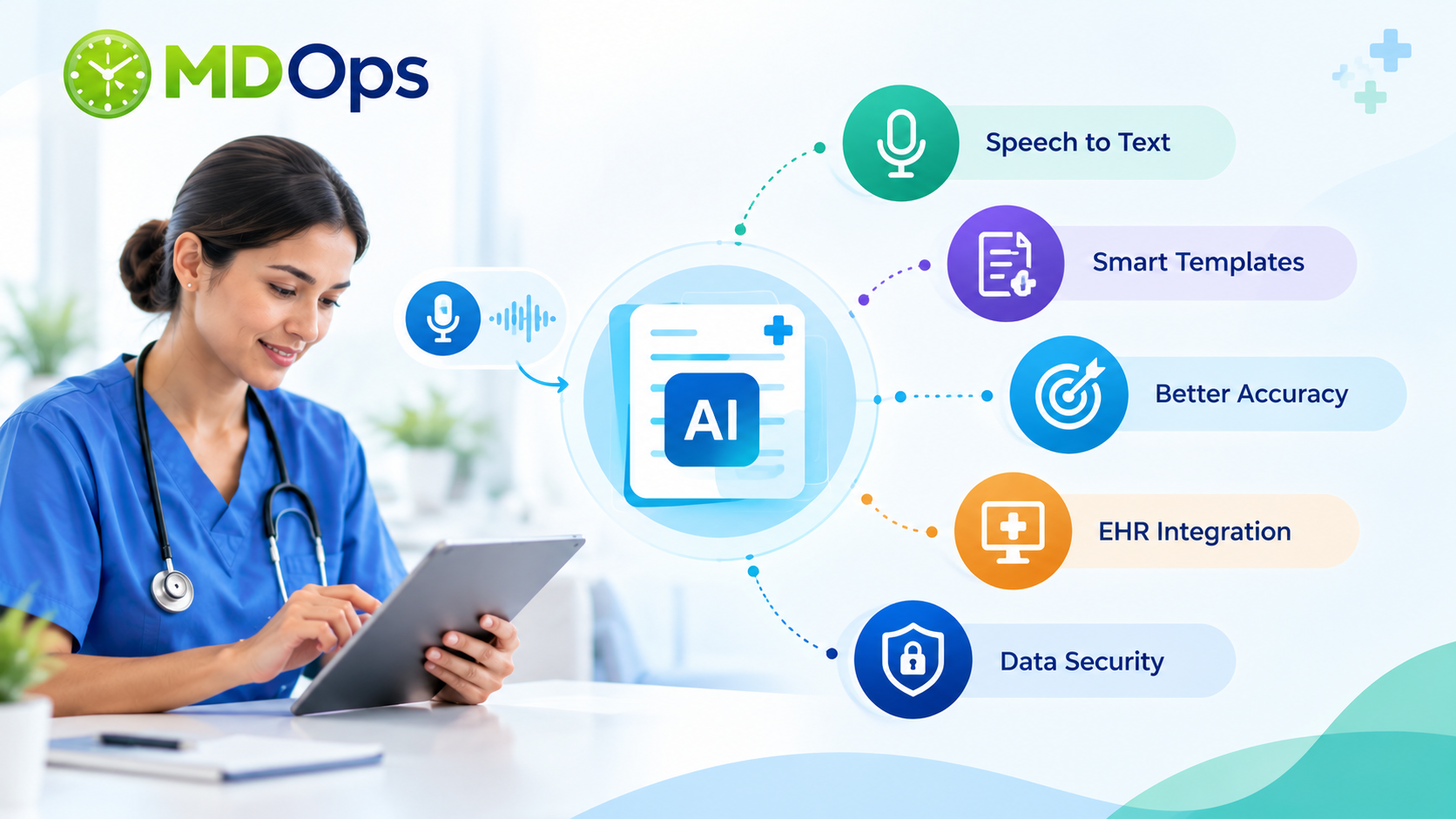
AI clinical documentation refers to technology that helps healthcare professionals create, organize, and review clinical notes using artificial intelligence. Depending on the software, it may process dictated speech, summarize clinical conversations, structure information into note templates, or identify missing fields that require attention.
Some tools use speech recognition and natural language processing to turn spoken observations into written drafts. Others can help organize information into sections such as presenting concerns, clinical observations, assessments, and follow-up plans.
For example, after assessing a resident, a practitioner may dictate relevant observations instead of manually typing every sentence. The system can then prepare a draft note for review. The practitioner checks the content, corrects errors, and approves the final record.
The technology’s capabilities vary by product. Not every tool can integrate with an electronic health record (EHR), understand long-term care terminology, or populate structured clinical fields automatically.
5 Ways AI Clinical Documentation Can Support Long-Term Care Practitioners
- Reducing Repetitive Documentation Tasks
One potential benefit of AI medical documentation is reducing the amount of routine typing and formatting required to complete clinical notes.
Practitioners may be able to dictate observations, use automated transcription, or generate an initial draft from a clinical conversation. Instead of starting with a blank page, they can review the draft and make the necessary corrections.
For example, a practitioner assessing a resident who reports increased discomfort may dictate the relevant symptoms, examination findings, and planned follow-up. An AI tool can help organize that information into a readable draft, depending on its features and configuration.
This can make documentation more convenient, although time savings depend on note complexity, transcription quality, and how much editing is required.
- Improving the Structure and Readability of Clinical Notes
Clear documentation helps care teams understand a resident’s condition and the actions taken during an assessment. Poorly structured notes can make relevant details harder to find, particularly when several practitioners contribute to a resident’s record.
AI tools can help organize information into consistent sections and improve grammar, formatting, and readability. For example, a documentation tool might separate a practitioner’s observations from the assessment and planned follow-up. This structure can make the note easier for another team member to review.
However, readability should never come at the expense of clinical accuracy. The system must preserve the original meaning and avoid adding details that were not observed, reported, or verified.
- Supporting More Consistent Recordkeeping
Long-term care organizations often use standardized templates to ensure that practitioners document required information. AI tools may support these processes by organizing notes according to approved formats or flagging fields that appear incomplete.
A well-configured AI clinical documentation system might help identify a missing section in a draft or remind a practitioner to review information required by the organization’s documentation policy.
These prompts should function as support rather than proof that a note is complete. A system may overlook important clinical context or incorrectly interpret a field, so practitioner review remains necessary. Consistency also depends on staff training, clear documentation standards, and integration with existing workflows.
- Supporting Communication Between Care Team Members
Long-term care depends on coordination among practitioners, nurses, care assistants, therapists, and other professionals. Clear records can help team members understand what was observed, what action was taken, and what needs attention next.
AI-supported tools can make notes easier to scan and may help organize follow-up instructions in a consistent format. For instance, if a practitioner documents a change in a resident’s mobility and recommends reassessment, a structured note can help the next team member locate that information more easily.
AI-generated summaries should not replace formal handover procedures, urgent communication, or direct escalation when a resident’s condition requires immediate attention. Important findings must be communicated through the appropriate clinical channels.
- Helping Practitioners Focus on Resident Care
Documentation is necessary, but it competes with other demands on a practitioner’s time. By assisting with transcription, formatting, and initial drafting, AI in healthcare may reduce some administrative friction.
The intended benefit is not to remove documentation from clinical practice. It is to make the process more manageable while preserving the detail and accountability required for safe care.
Organizations should assess whether an AI tool genuinely reduces work or simply shifts the burden to reviewing and correcting automated notes. Feedback from practitioners is essential to understanding the real impact.
How an AI Medical Assistant Fits Into the Documentation Workflow
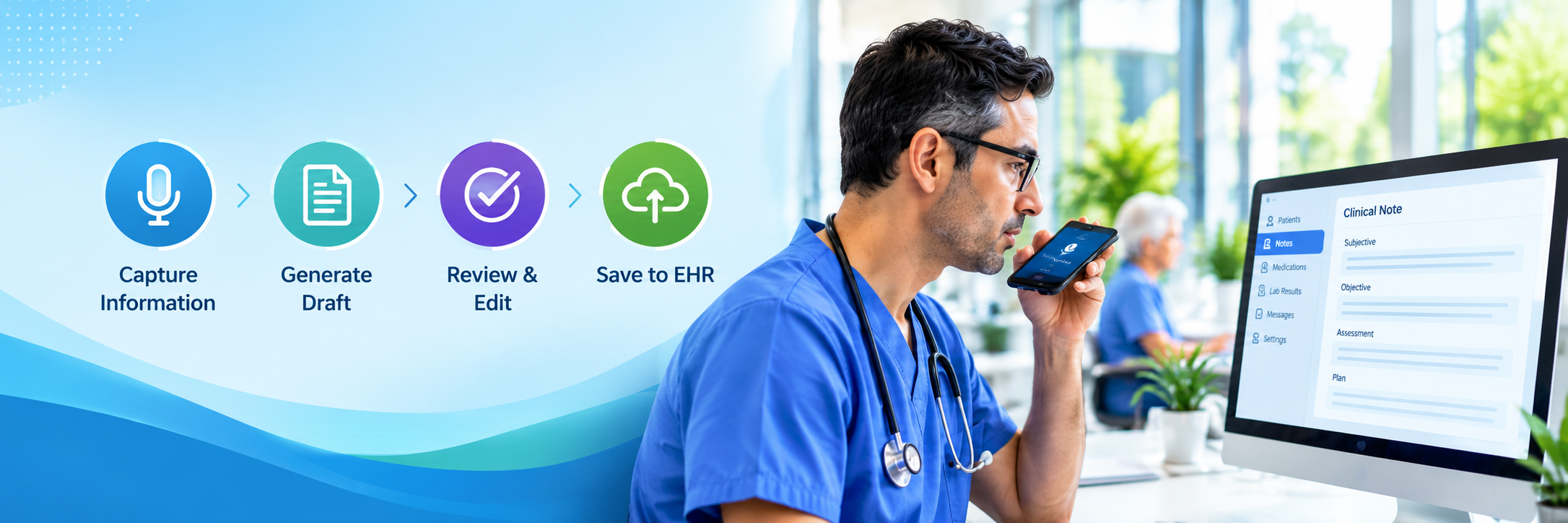
AI in long-term care can help practitioners streamline clinical documentation through voice dictation, structured draft notes, and EHR integration. A typical AI-powered process includes:
- Capture relevant information: The practitioner records observations through an approved dictation or documentation interface.
- Generate a draft: The software transcribes or organizes the supplied information into a draft note or template.
- Review and correct: The practitioner checks names, dates, clinical terminology, observations, and the accuracy of the note.
- Approve and save: The authorized practitioner finalizes the record and saves it according to organizational procedures.
This process keeps clinical responsibility with the practitioner while using automation to support the administrative steps. If the system integrates with an EHR, organizations should also verify that information is saved in the correct resident record and appropriate fields.
Key Considerations Before Implementing AI Medical Documentation
Adopting an AI tool requires more than selecting software with attractive features. Long-term care organizations should assess whether the system is safe, practical, and appropriate for their clinical environment.
Accuracy and clinical review
AI systems can mishear speech, misinterpret abbreviations, omit relevant details, or generate information that was never provided. Errors involving medication names, dosages, allergies, dates, or clinical findings can be particularly serious.
Practitioners should review generated notes before they become part of the official record. Organizations should establish clear policies about who can approve documentation and how errors are corrected.
Privacy and data protection
Clinical notes may contain sensitive resident information. Before using an AI tool, organizations should understand how data is collected, processed, stored, accessed, and retained.
The solution should meet applicable privacy, security, and healthcare requirements. Staff should use only approved systems and avoid entering identifiable resident information into unapproved AI applications.
Long-term care organizations should understand the administrative, physical, and technical safeguards required under the HIPAA Security Rule when selecting and implementing technology that handles electronic protected health information.
Integration with existing systems
A documentation tool that operates separately from an organization’s existing EHR may create additional work. Staff might have to copy information manually between systems, increasing the possibility of errors.
Before implementation, check whether the software integrates with the existing platform, supports the required note formats, and fits the organization’s actual documentation process.
Staff training and adoption
Practitioners need to understand what the tool can do, where it may fail, and how to verify its output. Training should include practical examples, privacy requirements, correction procedures, and escalation processes.
Staff feedback should also be collected during implementation. A tool that adds complexity or requires extensive editing may not deliver the expected benefits.
How to Measure the Impact of AI Clinical Documentation
Long-term care providers should evaluate results using practical measures rather than assuming that AI will automatically improve efficiency.
Useful indicators include:
- Documentation time: Compare the time required to complete similar notes before and after implementation.
- Correction rates: Track how frequently generated drafts require substantial edits.
- Completeness: Review whether required fields and relevant clinical details are consistently included.
- Staff experience: Ask practitioners whether the tool makes documentation easier or introduces new tasks.
- Workflow reliability: Monitor delays, duplicate records, and problems saving notes.
- Safety and privacy: Track documentation incidents, incorrect entries, and data-handling concerns.
Results should be reviewed across different note types and practitioner roles. A tool may perform well for routine progress notes but be less suitable for complex assessments. A controlled pilot can help organizations identify these differences before expanding use.
The Future of AI in Healthcare Documentation
AI documentation tools are evolving, but their value in long-term care will depend on how well they address everyday clinical needs. Systems that support accurate transcription, structured notes, and appropriate integration may become useful components of broader AI in healthcare strategies.
Future developments may include more tailored documentation templates, better recognition of clinical terminology, and improved connections between documentation and approved care workflows. These capabilities will still require validation, governance, and human oversight.
The goal should be practical: reduce avoidable administrative work without compromising resident privacy, documentation quality, or professional accountability.
Frequently Asked Questions
1. What is AI clinical documentation in long-term care?
AI clinical documentation uses artificial intelligence to assist with creating, organizing, or reviewing clinical notes. Depending on the tool, it may support speech transcription, draft generation, note formatting, and identification of potentially missing information.
2. Can AI medical documentation replace practitioners?
No. AI can assist with documentation tasks, but qualified practitioners must verify the content and take responsibility for the final clinical record. Automated notes should not be treated as accurate without review.
3. How does an AI medical assistant help with clinical notes?
An AI medical assistant may transcribe dictated observations, organize information into templates, and prepare draft notes. Its capabilities vary, so organizations should verify accuracy, integration options, and suitability for their documentation requirements.
4. Is AI clinical documentation secure for resident records?
Security depends on the specific solution and how it is implemented. Organizations should assess data protection, access controls, retention policies, vendor practices, and compliance with applicable requirements before processing resident information.
5. Does AI documentation save time in long-term care?
It may reduce typing and formatting work, but actual savings depend on the tool, the type of note, and the amount of correction required. A pilot that measures documentation time and error rates can help determine whether it offers a meaningful benefit.
Conclusion
Clinical documentation is a core part of safe, coordinated long-term care, but it can place considerable demands on practitioners. MDLog, MDops’ AI-powered clinical documentation solution, helps practitioners streamline documentation through voice-enabled dictation, structured note creation, and reduced manual data entry. This allows practitioners to spend less time on repetitive documentation tasks and more time focusing on resident care.
By using AI medical documentation and an appropriately configured AI medical assistant, care organizations may be able to make documentation workflows more manageable and improve the readability of clinical records. The results will depend on the technology’s accuracy, integration, and fit with existing processes.
Successful implementation requires practitioner oversight, strong privacy safeguards, staff training, and ongoing evaluation. When these elements are in place, AI in healthcare can support documentation without replacing the clinical judgment and personal attention that long-term care residents need. Get in touch today!