


Introduction
Long-term care practitioners manage more than resident assessments and clinical documentation. Their daily responsibilities also include reviewing patient information, preparing for facility rounds, coordinating with care teams, managing follow-up activities, and ensuring that important records are updated.
When these activities depend heavily on manual processes, administrative work can become difficult to manage. Repeated data entry, disconnected systems, delays in retrieving clinical information, and time-consuming coordination can interrupt everyday workflows.
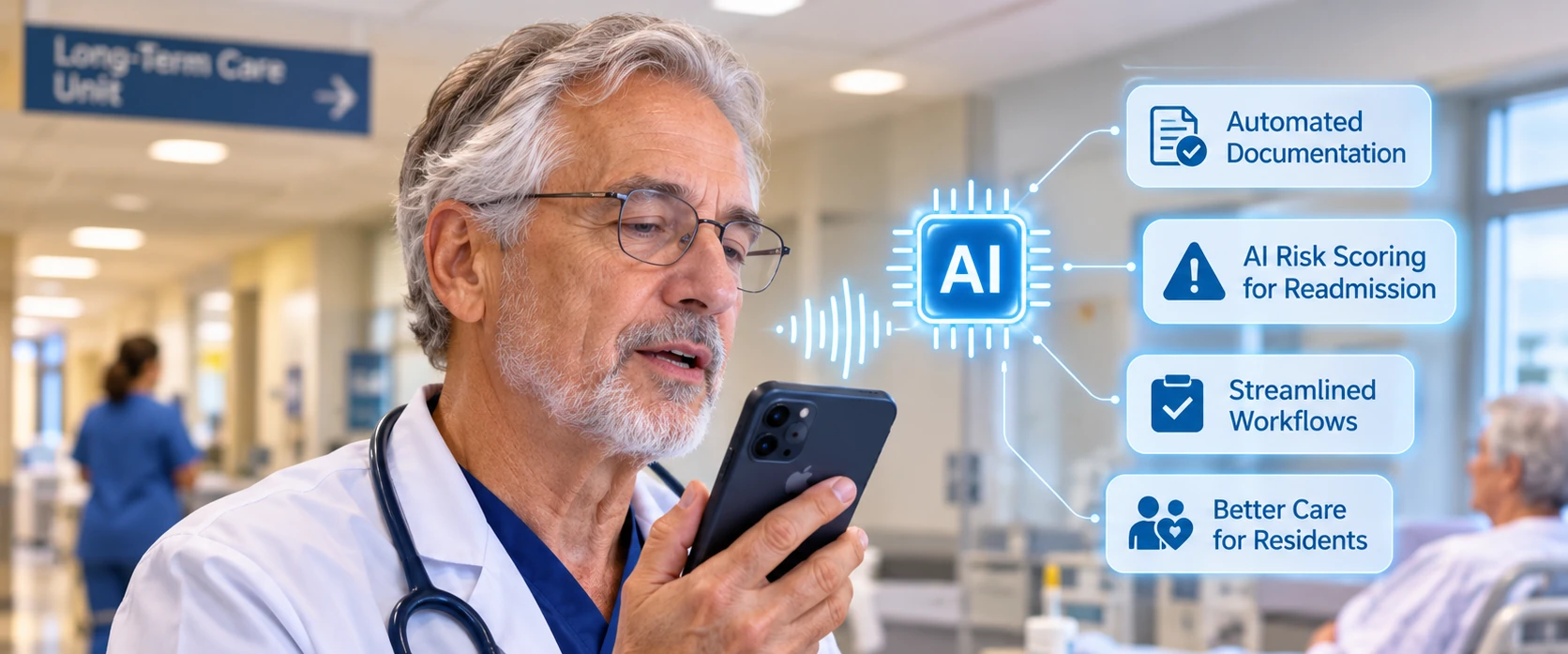
AI workflow automation offers a way to address some of these challenges. By combining artificial intelligence with automated processes, healthcare organizations can streamline selected administrative activities, organize information, and make routine tasks easier to manage.
For long-term care providers, the goal is not to automate every clinical decision. It is to reduce unnecessary manual work, improve access to relevant information, and help practitioners focus more of their time on resident care.
This article explores how AI automation can support daily long-term care operations, improve coordination between healthcare teams, and help organizations build more efficient workflows.
Why Long-Term Care Operations Need Better Workflows
Long-term care facilities depend on coordination among physicians, nurses, therapists, care assistants, administrative staff, and other healthcare professionals. Each team member contributes to resident care, making reliable communication and organized processes essential.
However, several operational challenges can affect daily productivity.
- Repetitive administrative work: Staff may need to enter similar information into multiple forms, records, or systems.
- Manual follow-up: Assessments, referrals, reviews, and other routine activities may depend on staff manually tracking their status.
- Fragmented information: Important resident details can be spread across electronic health records, messages, and separate applications.
- Communication delays: Changes in a resident’s condition or care requirements may need timely communication between team members.
- Unclear task ownership: Without an organized process, staff may be uncertain about who is responsible for completing or reviewing a particular task.
These challenges do not necessarily indicate poor staff performance. They often reflect workflows that have developed over time without sufficient integration or automation.
Appropriate healthcare workflow automation can help standardize suitable processes, make outstanding tasks more visible, and reduce unnecessary administrative steps.
What Is AI Workflow Automation in Long-Term Care?
AI workflow automation combines rule-based processes with artificial intelligence to support tasks that would otherwise require manual effort.
Traditional automation generally follows predefined instructions. For example, a system may send a reminder when an assessment is due or route a completed form to a designated team member.
AI-enabled automation can add capabilities such as extracting information from documents, summarizing text, categorizing incoming requests, or helping organize information for human review. The available features depend on the software and how it is configured.
In long-term care settings, automation may support activities involving:
- Clinical documentation and record management
- Facility rounding and patient information retrieval
- Appointment and assessment reminders
- Follow-up task coordination
- Administrative reporting
- Information sharing between connected systems
Not every task requires artificial intelligence. Some processes are handled more reliably through straightforward rule-based automation.
It is also important to distinguish administrative automation from clinical decision-making. AI may help organize information or flag something for review, but resident assessments, treatment decisions, and clinical responsibilities must remain with appropriately qualified professionals.
6 Ways AI Automation Can Improve Long-Term Care Operations
1. Reducing Repetitive Administrative Tasks
One of the most practical applications of workflow automation in healthcare is reducing repetitive tasks that consume staff time without directly contributing to clinical assessment.
For example, a care organization may use automation to route completed forms, send reminders about outstanding documentation, or transfer approved information between compatible systems.
Long-term care practitioners may also benefit from tools that reduce manual steps involved in preparing facility rounds and managing patient records.
When these processes are designed properly, staff can spend less time navigating administrative tasks and more time on resident care.
However, automation does not automatically eliminate workload. Organizations should evaluate whether a new process genuinely removes manual steps or simply creates additional review requirements.
2. Streamlining Clinical Documentation and Record Management
Clinical documentation is essential for maintaining accurate resident records and supporting communication between care team members. Yet preparing, checking, and submitting notes can involve several separate steps.
Clinical workflow automation can help organize the documentation process by directing notes through predefined stages, reminding staff about incomplete records, and routing information to the appropriate reviewer.
AI-enabled documentation tools may also assist with transcribing dictated observations or preparing structured draft notes, depending on their capabilities.
For example, after completing a resident assessment, a practitioner may dictate relevant observations using an approved application. The software can help prepare a draft note, which the practitioner reviews and corrects before finalizing it.
Solutions such as MDLog, MDops’ clinical documentation solution, support voice-enabled clinical documentation and practitioner workflows in long-term care.
The purpose of this technology is to make documentation more manageable while preserving accuracy and professional accountability. Practitioners must continue to review and approve their clinical records.
3. Improving Facility Rounds and Access to Patient Information
Preparing for facility rounds requires practitioners to identify which residents need attention and review the information relevant to their visits.
This process may involve checking resident lists, reviewing medication records, examining laboratory results, and locating previous clinical notes.
When information is spread across different systems, preparing for rounds can involve unnecessary navigation and repeated manual work.
Technology that integrates with facility electronic health records can help practitioners access relevant patient information and organize their rounding activities.
For example, MDops’ long-term care solution describes automated rounding-list generation and retrieval of clinical information, including medication and laboratory results, through its integration with PointClickCare and MatrixCare.
Learn more about the MDops long-term care workflow solution.
Improving access to relevant information can help practitioners prepare for patient visits more efficiently. Clinical findings and decisions must still be assessed and verified by the responsible healthcare professional.
4. Supporting Follow-Up and Task Coordination
Long-term care involves ongoing responsibilities, including reassessments, referrals, care plan reviews, and routine monitoring activities.
When follow-up depends entirely on manual tracking, tasks can become harder to manage during busy shifts or when responsibilities move between team members.
Healthcare workflow automation can support task coordination through reminders, assignment rules, and status tracking.
For example, when a practitioner records that a resident requires a follow-up assessment, an appropriately configured system may create a related task, assign it to the designated team member, and make its status visible to authorized staff.
Organizations should establish clear responsibility and escalation procedures for overdue or urgent tasks. Automated reminders should support communication, not replace direct escalation when a resident needs immediate attention.
5. Connecting Disconnected Healthcare Systems
A long-term care workflow may involve electronic health records, scheduling applications, clinical documentation tools, and separate administrative systems.
When these platforms do not communicate effectively, practitioners may need to switch repeatedly between applications or enter the same information more than once.
Healthcare workflow automation can connect compatible systems and reduce duplicated steps when suitable integrations are available and properly configured.
For example, MDops describes integration with major long-term care facility EHR platforms, including PointClickCare and MatrixCare. Its published solution information explains how practitioners can retrieve clinical data and post dictated clinical notes directly into the facility EHR.
You can explore the MDops EHR integration and long-term care capabilities.
Before implementing any integration, organizations should assess system compatibility, data accuracy, access permissions, and how errors will be identified and corrected.
Poorly designed integrations can spread incorrect information just as easily as they can improve efficiency.
6. Making Routine Administrative Processes More Consistent
Different staff members may complete the same administrative process in different ways. This can make it harder to track progress and ensure that important steps are completed across shifts and departments.
Clinical workflow automation can support consistency through predefined procedures, required fields, approval steps, and task-routing rules.
For example, an organization’s discharge workflow may include administrative checks, documentation requirements, and follow-up assignments. A structured process can help staff identify which steps have been completed and which still require attention.
Automation can also support administrative reporting and billing-related activities where suitable systems and integrations are available.
However, standardization should not prevent practitioners from responding to individual resident needs. Workflows should include appropriate exceptions and escalation paths for situations that require professional judgment.

A Practical Example of Workflow Automation in Long-Term Care
Consider a long-term care facility where practitioners manage several residents across different units. Before starting their rounds, they need to identify which residents require visits and review the relevant clinical information.
In a largely manual process, practitioners may need to check multiple records, prepare visit lists, retrieve medication details, and locate previous notes separately.
A more organized technology-supported workflow could look like this:
Step 1: Prepare the rounding list
The practitioner accesses an organized list of residents scheduled for review or requiring attention.
Step 2: Retrieve relevant patient information
Where the facility EHR integration supports it, the practitioner can access relevant information such as medication records, laboratory results, and previous clinical notes.
Step 3: Complete the resident assessment
The practitioner visits the resident, reviews their condition, and records the relevant observations.
Step 4: Prepare and submit clinical documentation
The practitioner can use an approved voice-enabled documentation tool to dictate notes. The resulting documentation is reviewed, corrected, and finalized before being saved to the appropriate record.
Step 5: Manage the next steps
Any required follow-up activities are handled through the organization’s established processes, with clear responsibility for completion and escalation.
This example demonstrates how different technologies can support connected stages of a long-term care workflow.
Not every stage requires AI. Some activities rely on EHR integration, predefined rules, or straightforward automation. The most appropriate approach depends on the organization’s requirements and the capabilities of its software.
How to Implement Healthcare Workflow Automation Successfully
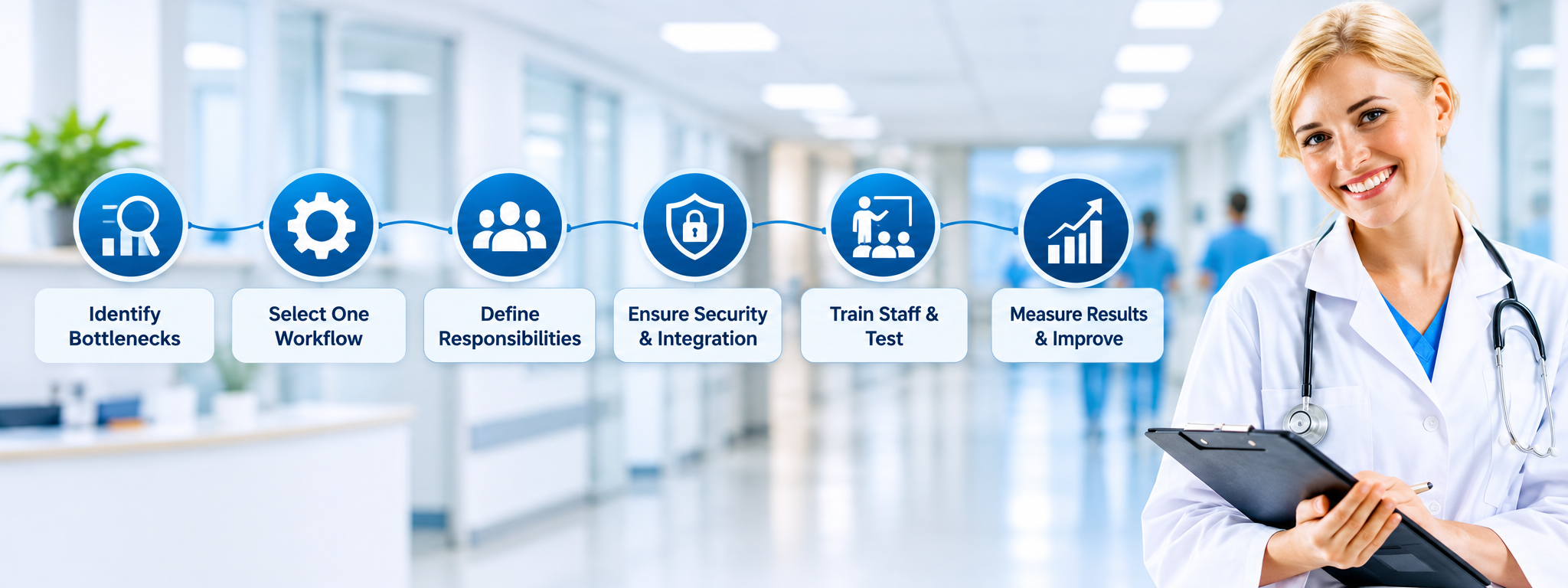
A successful implementation starts with understanding the workflow, not simply selecting software with attractive features.
Long-term care organizations should consider the following steps.
1. Identify the Main Operational Bottlenecks
Review daily processes with practitioners, nurses, and administrative staff.
Identify where repeated data entry, unclear task ownership, disconnected systems, or manual follow-up creates unnecessary work.
Focus on problems that have a meaningful effect on staff time and operational efficiency.
2. Select One Manageable Workflow
Start with a clearly defined process that can be evaluated without introducing unnecessary risk.
For example, an organization might begin with administrative reminders, document routing, or organizing non-urgent follow-up activities.
Avoid automating high-risk clinical decisions without appropriate validation, governance, and professional oversight.
3. Define Responsibilities and Escalation Rules
Every automated task should have a clear purpose and an assigned responsibility.
Organizations should establish:
- Who receives each task
- Who is responsible for completing it
- Who reviews or approves the result
- What happens when a task becomes overdue
- How urgent issues are escalated
Clear responsibilities help prevent automated processes from creating confusion.
4. Assess Security and System Integration
Before introducing a new platform, check whether it can work with existing systems and whether it meets applicable privacy and cybersecurity requirements.
Organizations handling electronic protected health information should understand the safeguards outlined in the HIPAA Security Rule.
This includes considering appropriate administrative, physical, and technical safeguards to protect the confidentiality, integrity, and availability of electronic health information.
Access permissions, audit trails, data handling, and vendor practices should also be reviewed before implementation.
5. Train Staff and Test the Process
Practitioners and administrative staff need to understand how the system works, what it can automate, and where human review is required.
Training should include practical examples, privacy requirements, correction procedures, and escalation processes.
Test the workflow before wider deployment. Confirm that information reaches the correct people, records are updated appropriately, and exceptions can be handled safely.
6. Measure Results and Improve
Collect feedback from staff and monitor the workflow after implementation.
Refine the process when automation creates unnecessary alerts, duplicates existing work, or fails to support real-world care requirements.
A successful implementation should make the workflow easier to manage rather than introduce additional complexity.
How to Measure the Effectiveness of Workflow Automation
Organizations should use measurable outcomes to determine whether automation is delivering value.
Useful indicators include:
- Time spent on administrative tasks: Compare the time required to complete selected activities before and after implementation.
- Task completion rates: Monitor whether assigned tasks are completed within the organization’s defined timeframes.
- Documentation quality: Review missing fields, duplicate entries, and correction rates.
- Workflow delays: Track where tasks remain pending and identify the reasons.
- Staff experience: Ask practitioners whether the system reduces effort or introduces additional work.
- System reliability: Monitor failed integrations, incorrect routing, and missed notifications.
- Safety and privacy incidents: Review whether the process introduces new risks or requires corrective action.
Evaluation should consider workload, safety, and service quality together.
Faster task completion alone does not prove that a workflow is better if documentation quality, communication, or resident care is affected.
Organizations should also compare results across different processes and staff roles. A system may work well for routine administrative activities but require additional review for more complex clinical workflows.
Common Mistakes to Avoid When Automating Healthcare Workflows
Even well-planned automation projects can create problems when the underlying workflow is not clearly defined.
- Automating an inefficient process: Automating unnecessary steps may make a poor process run faster without making it more useful. Review and improve the workflow before introducing automation.
- Relying on AI without verification: Generated summaries, classifications, and other AI-assisted outputs may be incorrect or incomplete. Important information should be reviewed by authorized staff.
- Creating too many alerts: Excessive notifications can distract staff and make important messages easier to overlook. Notifications should be relevant and prioritized according to the organization’s procedures.
- Ignoring staff feedback: Practitioners understand the daily workflow and can identify practical issues that may not be apparent during software demonstrations. Their feedback should be part of implementation and ongoing evaluation.
- Overlooking data protection: Resident information should only be processed through approved systems with appropriate safeguards. Organizations must assess how information is accessed, stored, shared, and retained.
Addressing these issues early can make workflow automation more practical and sustainable.
Frequently Asked Questions
1. What is AI workflow automation in long-term care?
It uses AI technology to simplify routine administrative and clinical workflows, helping care teams manage daily tasks more efficiently.
2. How can AI automation support long-term care practitioners?
It can reduce repetitive administrative work, support clinical documentation, and improve access to patient information.
3. Can AI automation reduce administrative workload?
Yes. It can help automate repetitive tasks, allowing practitioners to spend more time on resident care.
4. Does AI replace healthcare professionals?
No. AI supports practitioners with information and workflow tasks, while clinical decisions remain with qualified healthcare professionals.
5. How does MDops support long-term care workflows?
MDops provides solutions such as MDLog to support clinical documentation and long-term care workflow automation.
Conclusion
AI workflow automation can help long-term care organizations simplify daily tasks, improve coordination, and reduce administrative work while allowing practitioners to focus on resident care. MDops supports long-term care teams with AI-powered clinical documentation, EHR integration, rounding-list generation, and workflow automation.
Explore the MDops long-term care solution to learn how technology can make practitioner workflows more efficient.