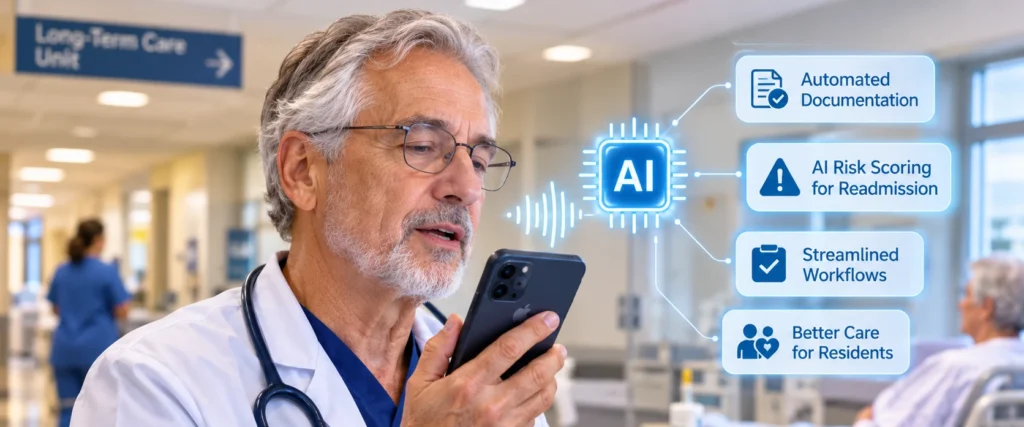



Hospital readmissions can interrupt recovery, increase healthcare costs, and create additional challenges for patients, families, and long-term care providers. For practitioners, one of the biggest challenges is recognizing when a patient’s condition may require further attention before the situation becomes more serious.
Patients returning from hospital often have complex care needs, ongoing medical conditions, medication changes, or reduced mobility. Monitoring these factors requires accurate documentation, regular assessments, and effective communication between healthcare professionals. When important information is scattered across different records, identifying potential risks can become difficult.
AI in long term care can help address this challenge by analyzing relevant patient information and identifying patterns associated with an increased risk of hospital readmission. When combined with clinical judgment and appropriate follow-up procedures, artificial intelligence can help practitioners make more informed decisions about patient monitoring and care planning.
Why Hospital Readmission Risk Matters in Long-Term Care
A patient’s discharge from hospital does not necessarily mean that recovery is complete. Many individuals require continued monitoring, medication management, rehabilitation, nutritional support, or assistance with everyday activities after returning to a long-term care facility.
If changes in a patient’s condition are not recognized promptly, complications may develop and require additional medical attention. Although some readmissions are unavoidable, appropriate follow-up and early intervention may help address certain preventable risks.
Traditional approaches to readmission prevention rely on discharge summaries, practitioner observations, scheduled assessments, and communication between healthcare teams. These processes remain essential, but they can become challenging when staff manage multiple patients and large volumes of clinical information.
This is where AI healthcare solutions can provide additional support. By helping care teams organize relevant information and identify patients who may need closer monitoring, AI can complement existing care processes.
The objective is not to eliminate every hospital readmission. It is to recognize potential concerns, address modifiable risks, and support continuity of care.
Reference: Hospital Readmissions Reduction Program
How Predictive Analytics in Healthcare Can Help Identify Readmission Risk
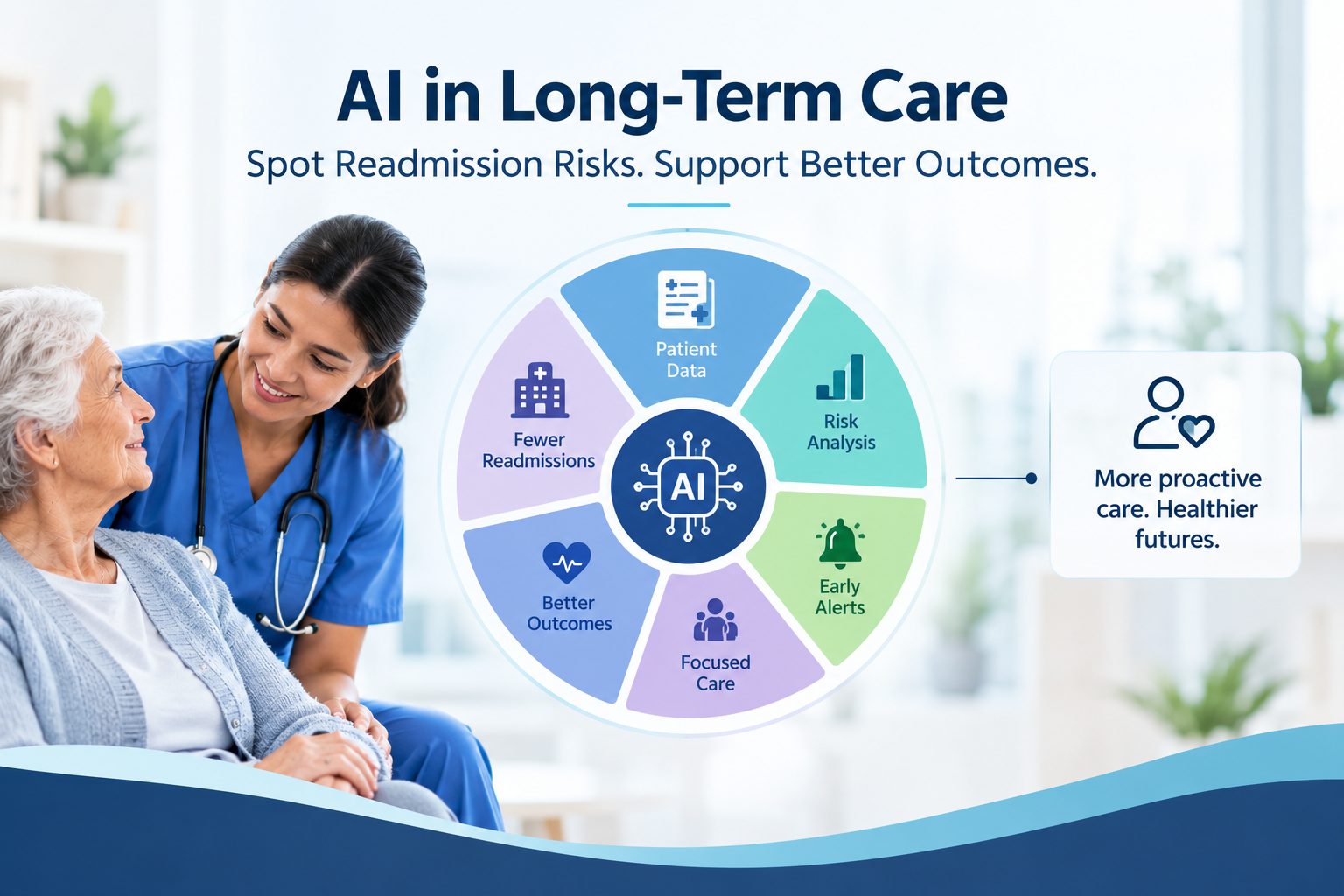
Predictive analytics in healthcare uses historical and current data to estimate the likelihood of a future event. AI-powered long-term care solutions can help practitioners identify patients who may need closer monitoring and prioritize follow-up care.
Depending on the model and its intended use, the system may analyze factors such as:
- Previous hospital admissions and emergency department visits.
- Existing medical conditions and recent complications.
- Medication changes and documented medication-related concerns.
- Changes in mobility, functional ability, or nutritional intake.
- Recent symptoms and relevant clinical observations.
- Discharge instructions and outstanding follow-up requirements.
The system processes the available information and generates a risk estimate, score, or alert. Practitioners can then review the result alongside the patient’s current condition and decide whether further assessment is necessary.
For example, a patient with several recent hospital admissions and new functional limitations may warrant closer review. An AI-supported system could flag relevant information for the care team, provided it has been designed and validated for that purpose.
However, a prediction is not a diagnosis. A high-risk score does not mean that readmission will definitely occur, and a low score does not guarantee that complications will not develop.
Identifying Warning Signs After Hospital Discharge
The period following hospital discharge can involve significant changes in medication, mobility, symptoms, and care requirements. Identifying these changes early is an important part of supporting recovery.
Consider a resident who returns to a long-term care facility following treatment for a respiratory condition. The discharge plan includes medication follow-up and regular observation.
Over the next few days, staff document reduced appetite, increasing fatigue, and lower activity levels. These observations may have several possible explanations, and they do not independently establish that the resident’s condition is worsening.
An AI-supported system may help bring these observations together with relevant clinical history and recent records. If the available information meets the model’s criteria, it could flag the case for further review.
The practitioner can then assess the resident, consider the clinical context, and determine whether additional monitoring or medical evaluation is appropriate.
This example demonstrates how AI can support the review process without replacing direct observation, clinical assessment, or professional judgment.
How AI Patient Risk Assessment Supports Individualized Care
Every patient has different medical needs, risk factors, and recovery requirements. A standardized approach may not adequately reflect these differences. AI patient risk assessment can help practitioners organize relevant information and identify patients who may benefit from a closer review of their existing care plans.
For example, one patient may require additional follow-up because of repeated hospital admissions, while another may need a reassessment after changes in mobility or medication.
Depending on the findings, the care team may consider:
- Reviewing the patient’s discharge and follow-up plan.
- Assessing whether medication reconciliation has been completed.
- Increasing observation when clinically appropriate.
- Reviewing nutritional intake, hydration, or functional changes.
- Coordinating an assessment with another healthcare professional.
- Updating the care plan based on the patient’s current needs.
These actions must be guided by the patient’s condition, applicable clinical protocols, and the judgment of qualified practitioners.
AI can help identify information that deserves attention, but it should not independently determine treatment or automatically change a patient’s care plan.
Improving Communication and Continuity of Care
Preventing avoidable readmissions often requires coordination between hospitals, long-term care facilities, primary care providers, pharmacists, rehabilitation professionals, and other members of the care team.
Important details can be missed when discharge instructions are incomplete, medication lists differ, or follow-up responsibilities are unclear. These gaps can make it harder for practitioners to maintain a consistent understanding of the patient’s needs.
AI-supported systems may help organize AI medical records and related clinical information into summaries that authorized professionals can review more efficiently. Depending on the available functionality, a system may also identify missing documentation or highlight follow-up tasks that remain outstanding.
For example, an AI-enabled workflow could flag that a recommended follow-up appointment has not been documented. Staff could then verify the information and contact the appropriate provider if necessary.
A well-integrated Healthcare AI platform may also help connect relevant information across existing clinical systems, reducing the need to search through disconnected records.
However, technology alone cannot ensure effective communication. Clear handover procedures, accurate documentation, and direct communication between healthcare professionals remain essential.
Integrating AI Into a Hospital Readmission Prevention Workflow
AI is most useful when its insights lead to a clear and appropriate response. An AI-powered practitioner workflow can help organize clinical information and support timely review of patient needs.
A practical workflow may include the following steps:
- Review Discharge Information: Confirm that the patient’s discharge summary, medication information, clinical instructions, and follow-up arrangements have been received and documented.
- Assess the Patient’s Current Condition: Complete the appropriate clinical assessments and review any new symptoms or changes in functioning. Do not rely solely on an AI-generated score.
- Review AI-Generated Risk Alerts: Examine the available information and determine why the system has flagged the patient. Verify that the information is accurate, current, and relevant.
- Determine Appropriate Follow-Up: Where clinically indicated, arrange additional monitoring, medication review, medical assessment, or communication with another healthcare professional.
- Document Actions and Outcomes: Record the assessment, decisions, referrals, and follow-up arrangements so other team members can understand the patient’s current care plan.
This approach helps integrate AI into existing care processes instead of creating a separate stream of alerts that staff may struggle to manage.
Challenges and Limitations of AI-Based Readmission Prediction
Although AI can support risk identification, its effectiveness depends on several important factors.
- Data Quality and Completeness: Predictive models rely on the quality of the information available to them. Missing records, outdated medication lists, inconsistent documentation, or incomplete discharge information can affect the accuracy of predictions. Providers should establish processes for maintaining accurate records and identifying missing or conflicting information.
- False Alerts and Missed Risks: A model may flag a patient who does not experience the predicted outcome. It may also fail to identify a patient who subsequently requires hospital care. Too many unnecessary alerts can create additional work and make staff less responsive to important notifications. Conversely, an unflagged patient must never be assumed to be free of risk.
- Differences Between Patient Populations: A model developed in one healthcare setting may not perform equally well in another. Patient characteristics, available services, documentation practices, and care processes can all influence its performance. Organizations should evaluate whether a model is appropriate for their own patient population and monitor its performance after implementation.
- Privacy and Information Security: Patient records contain sensitive information. Before introducing an AI tool, providers should review how data are collected, processed, stored, and shared. Appropriate access controls, security safeguards, vendor agreements, and compliance with applicable data protection requirements are essential. Reference: The HIPAA Security Rule
How to Evaluate AI Healthcare Solutions Before Implementation
Selecting an AI tool should begin with a clearly defined clinical or operational need.
For example, a facility experiencing incomplete discharge handovers may need to improve its documentation and follow-up processes before investing in predictive analytics.
Before adopting a solution, providers should evaluate:
- Clinical validation: Has the system been evaluated for its intended purpose and patient population?
- Data quality: Can it access sufficiently accurate and current information?
- System integration: Does it work with existing clinical records and workflows?
- Transparency: Can practitioners understand the purpose and limitations of its risk alerts?
- Staff training: Do users know how to interpret results and escalate concerns?
- Performance monitoring: Can the organization measure accuracy, alert volume, and practical outcomes?
A small pilot can help determine whether the technology improves the intended process before it is introduced more widely.
Measuring the Impact of AI on Hospital Readmissions
The effectiveness of an AI solution should be evaluated using measurable outcomes rather than assumptions about what the technology can achieve.
Long-term care organizations may monitor readmission rates over an appropriate period, completion of post-discharge follow-ups, medication reconciliation, response times to alerts, and the proportion of alerts that lead to meaningful clinical review. They should also assess staff workload, documentation quality, and patient safety.
Readmission rates need careful interpretation because they are influenced by many factors, including patient complexity, staffing, access to medical services, and the quality of discharge planning.
A change in readmission rates alone does not prove that an AI system caused the improvement. Providers should evaluate results alongside other relevant changes in care delivery.
Frequently Asked Questions
1. Can AI predict hospital readmissions in long-term care?
AI models can estimate the likelihood of hospital readmission using relevant patient information. Their performance depends on data quality, the model’s intended use, and validation in the population where it is applied. Predictions support clinical review rather than guarantee an outcome.
2. How does predictive analytics help long-term care practitioners?
Predictive analytics can help practitioners identify patterns in patient information, highlight potential risks, and prioritize cases for further assessment. It can complement routine observations and clinical judgment when integrated into an appropriate care workflow.
3. Can AI prevent hospital readmissions?
AI alone cannot prevent hospital readmissions. It may help identify patients who need additional attention, but any benefit depends on appropriate clinical assessment, timely intervention, effective discharge planning, and coordination between healthcare providers.
4. What should long-term care providers consider before adopting AI?
Providers should assess clinical validation, data quality, privacy, security, integration with existing systems, staff training, and ongoing performance monitoring. They should also ensure that practitioners remain responsible for clinical decisions.
Conclusion
AI in long term care can help practitioners identify patients who may need additional attention following hospital discharge. By using Predictive analytics in healthcare to organize relevant patient information, care teams can identify potential concerns, review follow-up requirements, and support more coordinated care.
However, successful implementation depends on reliable data, appropriate clinical validation, effective workflows, and continued human oversight. AI-generated risk estimates should inform clinical assessment rather than replace it.
For long-term care providers, the most practical approach is to combine AI-supported insights with regular patient observation, individualized care planning, and timely communication between healthcare professionals.
When used responsibly, AI healthcare solutions can support more structured risk identification and help practitioners focus their attention where further assessment may be needed, while keeping patient needs and professional judgment at the center of care. For more details about us!