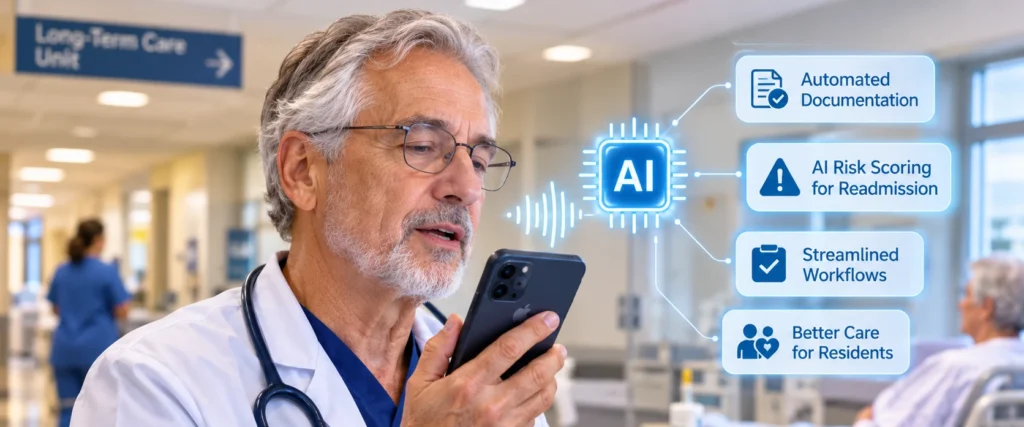



Introduction
Long-term care (LTC) physicians and healthcare practitioners manage residents with complex medical conditions, ongoing treatment requirements, and varying levels of care needs. Some residents remain clinically stable, while others may experience changes in their health that require closer monitoring and timely medical attention.
One of the important challenges for long-term care providers is identifying patients who may be at increased risk of hospital readmission. Recognizing potential risks early can help practitioners determine whether additional assessments, follow-up care, or changes to existing care plans are needed.
However, healthcare teams often work with large amounts of patient information, including clinical notes, medical histories, medication records, vital signs, assessment results, and previous hospital visits. Reviewing all this information manually can be time-consuming, particularly in busy skilled nursing facilities (SNFs).
This is where AI risk scoring in long-term care can help. AI-powered healthcare analytics can analyze relevant patient information, identify patterns associated with specific outcomes, and generate risk scores or alerts for clinical review.
When used appropriately, these tools can support physicians in identifying patients who may need additional attention and prioritizing clinical reviews.
This article explores how AI risk scoring works in long-term care, how it can support hospital readmission risk assessment, its practical applications for physicians, and how AI-powered solutions such as MDops MDLog support clinical workflows.
Why Is High-Risk Patient Identification Important in Long-Term Care?
Hospital readmissions can create additional challenges for patients, families, and healthcare providers. For residents in long-term care facilities, returning to the hospital may involve additional treatment, changes in care arrangements, and potential disruptions to ongoing recovery.
Identifying patients who may be at increased risk of readmission is an important part of coordinated care.
Long-term care physicians may face several challenges when reviewing patient risk.
- Complex Medical Histories
Many residents have multiple chronic conditions, previous hospital admissions, medication requirements, and ongoing treatment needs. Understanding how these factors influence a patient’s overall health requires reviewing information from different sources.
- Changes in Patient Conditions
A resident’s health can change between scheduled assessments. New symptoms, changes in mobility, medication-related concerns, or other clinical developments may require additional evaluation.
- Fragmented Patient Information
Important patient information may be stored across different healthcare records and systems. Accessing and reviewing relevant details can become difficult when information is not readily available in one place.
- Limited Time for Clinical Reviews
Physicians and practitioners must balance patient visits, clinical documentation, medication reviews, care coordination, and administrative responsibilities.
- Identifying Patients Who Need Priority Attention
Healthcare teams may need to review many residents during a single facility visit. Identifying which patients require additional assessment can be challenging without an organized review process.
AI-powered risk assessment tools can help organize relevant information and highlight patterns that may require further clinical review.
The goal is not to replace professional judgment but to provide another source of information that supports informed patient care.
What Is AI Risk Scoring in Healthcare?
AI risk scoring in healthcare refers to the use of artificial intelligence, statistical analysis, and predictive models to estimate the likelihood of a defined health outcome.
Depending on the intended purpose, these systems may assess hospital readmission risk, identify patterns associated with clinical deterioration, or support other specific healthcare assessments.
For long-term care providers, hospital readmission risk scoring can help practitioners identify residents who may benefit from additional monitoring or follow-up.
A typical AI risk-scoring process involves five steps:
- Patient Data Collection
The system receives relevant and authorized information from available clinical records or connected healthcare systems.
- Data Analysis
The AI model analyzes selected patient information and evaluates patterns associated with the outcome it has been designed to assess.
- Risk Score Generation
The system generates a risk score, category, or alert based on its analysis.
- Clinical Review
A qualified physician or practitioner reviews the result alongside the patient’s medical history, current condition, and other relevant information.
- Appropriate Follow-Up
Based on the complete clinical assessment, the care team determines whether additional monitoring, further evaluation, or follow-up care is necessary.
The usefulness of an AI risk score depends on the quality of the available data, the model’s validation, and whether it is appropriate for the population being assessed.
How AI Patient Risk Assessment Can Help Long-Term Care Physicians
AI patient risk assessment can support several aspects of long-term care practice. When integrated into clinical workflows, these capabilities can help practitioners organize patient information and identify situations that deserve additional attention.
- Identifying Residents Who May Need Closer Monitoring
A resident’s health status may change over time due to chronic conditions, new symptoms, medication changes, or other clinical factors.
AI-powered risk assessment tools can analyze relevant information and identify patterns that may indicate an increased risk of a specific outcome.
For example, a resident with a recent hospital admission and changes in documented health conditions may require additional clinical review, depending on the assessment model and the patient’s circumstances.
A risk alert does not confirm that an adverse event will occur. Instead, it provides an additional signal that practitioners can consider when determining appropriate next steps.
- Supporting Hospital Readmission Risk Assessment
Hospital readmission is an important concern for skilled nursing facilities and post-acute care providers, particularly when residents transition from hospitals to ongoing care environments.
Relevant considerations may include:
- Previous hospital admissions.
- Existing medical conditions.
- Recent clinical changes.
- Medication-related concerns.
- Hospital discharge instructions.
- Follow-up care requirements.
Predictive analytics in healthcare can help analyze relevant information to estimate the likelihood of a defined outcome, such as hospital readmission within a specified period.
For example, a patient identified as having an elevated readmission risk may need a closer review of discharge instructions, medication reconciliation, follow-up appointments, or ongoing monitoring requirements.
The physician can use this information alongside clinical observations to determine whether additional care coordination or intervention is appropriate.
- Recognizing Patterns Across Multiple Patient Data Points
A single clinical observation may not provide a complete picture of a resident’s health.
In some situations, changes across multiple relevant data points may provide additional context for clinical assessment.
AI healthcare analytics can evaluate selected information together, provided the variables are relevant to the model’s intended purpose.
For example, a validated model may use previous hospital utilization and other relevant clinical information to estimate readmission risk.
This can help practitioners identify residents who may require closer review rather than relying exclusively on individual observations.
However, different models use different data and should only be applied to the outcomes for which they have been developed and validated.
- Helping Physicians Prioritize Clinical Reviews
Long-term care physicians may need to review multiple residents during facility visits. Prioritizing these reviews can be challenging when patient information is spread across different records.
AI risk scoring can support this process by highlighting residents whose estimated risk meets predefined review criteria.
For example, a clinical dashboard may help practitioners identify residents who have been flagged for additional assessment.
This can support a more organized review process and help healthcare teams focus their attention on relevant patient concerns.
However, risk scores should never override urgent clinical observations. A resident experiencing sudden breathing difficulties, chest pain, or another emergency symptom requires immediate assessment according to established clinical procedures, regardless of their calculated risk score.
- Supporting Individualized Care Planning
Risk assessment is most useful when it contributes to appropriate patient care.
After reviewing a risk score or alert, practitioners can determine whether the resident’s existing care plan remains suitable or requires further assessment.
Depending on the clinical situation, this may involve:
- Reviewing existing monitoring arrangements.
- Checking medication information.
- Assessing follow-up requirements.
- Coordinating with nursing staff.
- Discussing concerns with the appropriate healthcare professional.
- Reassessing individual care goals.
AI patient risk assessment can provide additional information for these reviews, but care decisions must reflect the resident’s individual needs, preferences, and clinical circumstances.
How MDLog Supports AI-Powered Risk Assessment in Long-Term Care
Long-term care physicians need timely access to relevant patient information to recognize potential concerns and organize clinical reviews.
MDops MDLog provides AI-powered capabilities designed to support long-term care practitioners with patient information management, risk assessment, and clinical documentation workflows.
Its AI capabilities include:
1. Accurate Hospital Readmission Risk Scores
MDLog provides AI-powered readmission risk scores to help practitioners review patient risk and identify individuals who may require additional attention.
These scores can support clinical reviews and help physicians consider which patients may benefit from closer monitoring or follow-up.
2. AI-Generated History and Physical (H&P) Notes
MDLog can generate History and Physical documentation from a hospital discharge summary with a single click.
This helps practitioners prepare structured clinical documentation using available hospital information.
3. Quick Summaries of Previous Patient Care
Reviewing previous patient information is an important part of understanding a resident’s current healthcare needs.
MDLog provides quick summaries of past patient care to help practitioners access relevant clinical context during patient reviews.
4. Structured Clinical Notes From Voice Dictation
Clinical documentation can take considerable time, particularly when physicians need to prepare detailed notes for multiple residents.
MDLog can automatically generate structured clinical notes from single-field dictation, helping practitioners reduce manual documentation tasks.
5. Patient Alerts for Proactive Care
Patient alerts can help practitioners identify situations that may require attention and support timely clinical review.
These alerts provide another way to organize patient information and support proactive care workflows.
Together, these capabilities are designed to help long-term care practitioners manage patient information, review potential risks, and streamline clinical documentation.
Explore how MDops MDLog supports AI-powered Long-Term Care workflows.
The Role of Predictive Analytics in Hospital Readmission Prevention
Predictive analytics in healthcare uses statistical methods and machine learning to analyze relevant information and estimate the likelihood of future events.
In long-term care, predictive models may be developed for specific purposes, such as estimating hospital readmission risk or identifying patients who may require additional clinical assessment.
Potential applications include:
- Estimating the likelihood of hospital readmission within a defined period.
- Identifying patterns associated with changes in patient health.
- Supporting risk-based patient reviews.
- Highlighting patients who may require additional follow-up.
- Analyzing trends across a facility or patient population.
- Supporting the evaluation of clinical monitoring processes.
For example, a skilled nursing facility may use a validated readmission risk model to help practitioners identify residents who may benefit from additional assessment after hospital discharge.
However, predictive analytics does not establish certainty. A model estimates risk based on available information and learned patterns. Its performance may vary across different patient populations and care settings.
For this reason, healthcare organizations should validate models for their intended use and monitor their performance after implementation.
How AI Healthcare Analytics Supports Clinical Decision-Making
AI healthcare analytics can help healthcare organizations organize relevant information and present it in a format that practitioners can review.
Depending on available integrations and permissions, this information may include medical histories, previous hospital visits, assessment records, medication information, and other clinical details.
A practical workflow may involve the following steps:
Step 1: Gather Relevant Patient Information
Approved clinical information is collected from appropriate records and connected healthcare systems.
Step 2: Generate a Risk Estimate
A validated model analyzes relevant variables and generates a risk score or category.
Step 3: Review Patient Information
A qualified practitioner reviews the result alongside the resident’s medical history and current health condition.
Step 4: Determine Appropriate Follow-Up
The healthcare team decides whether further assessment, monitoring, or coordination is required.
Step 5: Document Clinical Decisions
The practitioner records relevant findings, assessments, and follow-up plans in the appropriate clinical documentation system.
This workflow illustrates how AI healthcare analytics can support clinical processes without independently determining treatment decisions.
Important Limitations of AI Risk Scoring in Long-Term Care
Although AI risk scoring can provide useful information, healthcare organizations should understand its limitations before implementing these systems in clinical environments.
- Data Quality and Completeness
Missing, outdated, duplicated, or incorrect information can affect the reliability of a risk estimate.
Healthcare organizations should establish processes to maintain accurate patient records and address data-quality issues.
- False Positives and False Negatives
A false positive occurs when a system identifies a patient as high risk but the predicted outcome does not occur.
A false negative occurs when the system fails to identify a patient who later experiences the predicted outcome.
Both situations matter. Too many false alerts may increase the workload for clinical teams, while missed alerts may create a false sense of security.
- Bias and Unequal Model Performance
AI models may perform differently across patient populations if the information used to develop or validate them does not adequately represent the individuals being assessed.
Healthcare organizations should evaluate model performance across relevant groups and investigate potential differences.
- Lack of Complete Clinical Context
A numerical score cannot fully represent a resident’s individual circumstances, preferences, symptoms, or every factor influencing their health.
Physicians must retain the ability to question a score, consider additional information, and use their professional judgment.
- Patient Privacy and Data Security
AI risk-scoring systems may process sensitive health information.
Healthcare providers should verify that appropriate security measures, access controls, privacy protections, and data governance processes are in place.
Best Practices for Implementing AI Risk Scoring in Long-Term Care
Before introducing AI risk-scoring technology, long-term care organizations should establish a clear implementation and oversight process.
- Define the Intended Outcome
Determine whether the model is designed to estimate hospital readmission risk or support another specific clinical assessment.
Avoid applying a model to outcomes for which it has not been developed or validated.
- Validate the Model for the Intended Population
Review available evidence to determine whether the model performs appropriately for the patient population and care setting in which it will be used.
- Establish Clear Alert-Response Procedures
Define who reviews alerts, how they are prioritized, and what steps should be followed when additional clinical assessment is required.
- Keep Qualified Professionals Involved
Physicians and other qualified practitioners should interpret risk scores and remain responsible for clinical decisions.
- Monitor Model Performance
Regularly evaluate model performance, missing data, alert volume, false positives, false negatives, and changes in accuracy over time.
- Protect Patient Information
Establish suitable security measures, access permissions, privacy policies, and organizational data governance procedures.
- Train Healthcare Staff
Ensure that staff understand what a risk score means, what it cannot establish, and how to respond when clinical observations differ from the system’s output.
These practices help make AI risk scoring a responsible part of clinical workflows rather than an unexamined automated decision-making process.
How to Measure the Effectiveness of AI Risk Scoring
Healthcare organizations should evaluate whether a risk-scoring tool performs as intended and supports the clinical process it was designed to improve.
Important measures include:
- Model Accuracy: How well does the model distinguish patients who experience the predicted outcome from those who do not?
- Sensitivity: How frequently does the model identify patients who subsequently experience the predicted outcome?
- Positive Predictive Value: Among patients flagged as high risk, how many actually experience the predicted outcome?
- Calibration: Do the estimated risk levels correspond reasonably well with observed outcome rates?
- Alert Workload: How many alerts are generated, and how many require meaningful clinical review?
- Clinical Response: Are identified concerns reviewed and addressed according to established procedures?
- Equity: Does the model perform consistently across relevant patient populations?
- Operational Impact: Does the system support clinical workflows without creating excessive administrative work?
These measures should reflect the model’s intended purpose. A model that performs well in one healthcare environment may not perform equally well in another.
Organizations should evaluate both technical performance and whether the tool supports meaningful improvements in real-world clinical processes.
Frequently Asked Questions
- What is AI risk scoring in healthcare?
AI risk scoring in healthcare uses artificial intelligence and analytical models to estimate the likelihood of a defined health outcome. It can help identify patterns associated with increased risk and provide additional information for clinical review.
- How can AI risk scoring help long-term care physicians?
AI risk scoring can help long-term care physicians identify patients who may require additional assessment by analyzing relevant clinical information and highlighting patterns associated with a specific risk.
- Can AI help predict hospital readmissions in skilled nursing facilities?
AI-powered predictive models can estimate hospital readmission risk using relevant patient information. These estimates can help practitioners prioritize clinical reviews and consider appropriate follow-up care.
- What is the role of predictive analytics in healthcare?
Predictive analytics uses statistical methods and machine learning to analyze healthcare information and estimate the likelihood of future outcomes. It can support patient risk assessment, clinical reviews, and healthcare planning.
- How does AI clinical documentation support long-term care physicians?
AI clinical documentation tools can help physicians prepare structured medical notes, organize patient information, and reduce repetitive documentation tasks. This can support more efficient clinical workflows.
- Can AI risk scoring prevent hospital readmissions?
AI risk scoring may help identify patients who could benefit from additional monitoring or follow-up. However, a risk score alone cannot prevent readmissions. Outcomes depend on clinical decisions, appropriate interventions, patient circumstances, and coordinated care.
- Is AI risk scoring reliable for every patient?
No AI model should be assumed to perform equally well for every patient. Its reliability depends on data quality, model validation, the population being assessed, and the specific outcome being predicted. Clinical judgment remains essential.
Conclusion
Identifying patients who may need additional clinical attention is an important part of long-term care. AI risk scoring can help physicians organize relevant patient information, identify patterns associated with specific outcomes, and support hospital readmission risk assessment.
Through predictive analytics in healthcare and AI-powered patient risk assessment, long-term care practitioners can gain additional information to support clinical reviews and prioritize appropriate follow-up.
Solutions such as MDops MDLog bring together AI-powered readmission risk scores, patient care summaries, automated H&P documentation, structured voice-based clinical notes, and patient alerts to support long-term care workflows.
When combined with validated models, reliable patient information, and appropriate clinical oversight, these capabilities can help healthcare providers organize patient reviews and support more proactive care.
Discover how MDops helps Long-Term Care physicians streamline clinical workflows and support informed patient care with its AI-powered Long-Term Care solution.